-
 Deliver to India
-

+91 7404444419
-

Lexbaxindiapvtltd@gmail.com
Deliver to India
+91 7404444419
Lexbaxindiapvtltd@gmail.com
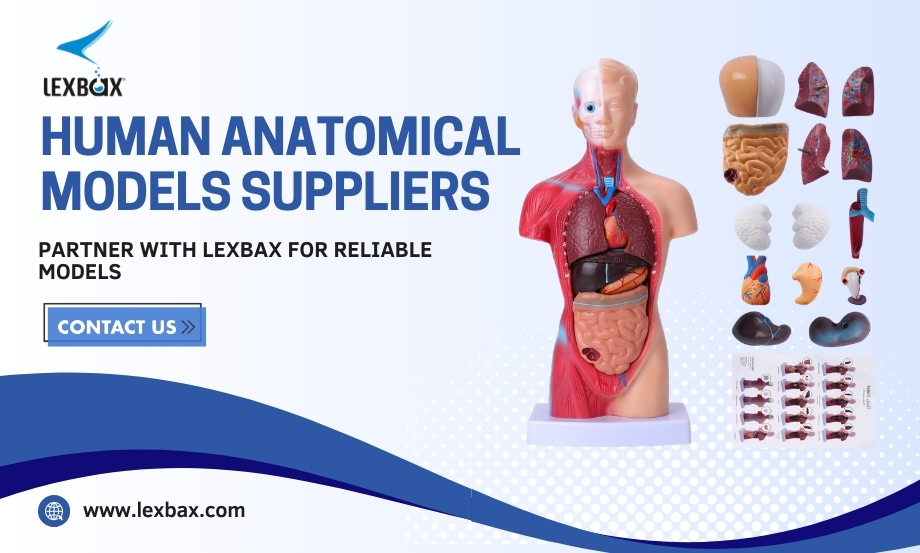
The demand for accurate medical teaching tools is growing rapidly as healthcare education becomes more advanced and technology-driven. One of the most essential tools used in medical schools, research institutions, and healthcare training centers is the human anatomical model. These models help students and professionals understand the complex structure of the human body in a practical and visual way.
As one of the trusted human anatomical model suppliers, Lexbax provides high-quality anatomical teaching models designed for educational institutions, hospitals, laboratories, and medical training centers. These models replicate real human body structures, helping learners explore anatomy through a clear and hands-on approach.
A human anatomical model is a three-dimensional representation of the human body or specific organs that helps learners understand anatomical structures in detail. These models can represent entire body systems or specific parts such as the skeleton, brain, heart, muscles, or organs.
Unlike textbooks or diagrams, anatomical models provide a physical, visual, and interactive learning experience. Medical students and healthcare professionals can observe the relationships between organs, tissues, and body systems more effectively through these models.
Historically, anatomical models were developed to support medical education when access to cadavers was limited. Over time, they have evolved into highly accurate educational tools used in universities, hospitals, and research labs worldwide.
Modern healthcare education relies heavily on visualization and practical learning. A human anatomical model allows students to study anatomy through hands-on interaction rather than only theoretical learning.
Human anatomical models provide a 3D representation of the human body, making it easier to understand complex anatomical structures. This helps learners observe how organs and tissues interact with each other.
In many institutions, cadaver dissection may be limited or unavailable. Anatomical models allow students to investigate body systems without the ethical or logistical concerns associated with cadaver use.
Unlike biological specimens, anatomical models are durable and reusable. They can be used repeatedly in classrooms and laboratories, making them a cost-effective learning tool.
These models simplify complicated concepts by clearly displaying organs, muscles, bones, and nerves in an organized format.
Professional human anatomical models suppliers like Lexbax provide a wide variety of models designed for different educational and clinical purposes.
These models represent the entire human body, showing multiple systems such as skeletal, muscular, and organ structures. They help students understand the overall organization of the human body.
Skeleton models display the structure of bones and joints in the human body. They are widely used in anatomy classes to study bone structure and movement.
These models represent individual organs, such as:
Organ models allow students to study the structure and function of specific organs in detail.
Muscle models show the arrangement and structure of muscles across the body. These are commonly used in physiotherapy and sports science education.
Joint models demonstrate how bones connect and move, helping students understand body movement and biomechanics.
Reliable human anatomical models suppliers focus on accuracy, durability, and usability. Companies like Lexbax manufacture anatomical models with features that support modern medical education.
High-quality anatomical models are created based on real human anatomy to ensure accurate representation for educational purposes.
Most anatomical models are made from materials such as PVC, resin, or silicone, which provide strength and long-term usability in classrooms and laboratories.
Many models use color coding to differentiate organs, tissues, and systems, making it easier for students to identify structures.
Some anatomical models allow users to remove organs or layers, helping learners understand internal structures more effectively.
Human anatomical models are widely used across the healthcare and education industries.
Medical Education: Medical colleges and universities use anatomical models to teach students about human body systems and anatomical structures.
Nursing and Healthcare Training: Nursing students and healthcare professionals use these models to learn about organ systems, disease processes, and patient care procedures.
Physiotherapy and Sports Science: Anatomical models help physiotherapists understand muscle movements, joint mechanics, and rehabilitation techniques.
Clinical Demonstration: Doctors often use anatomical models to explain medical conditions and treatment procedures to patients.
Medical Research and Training: Research institutions use anatomical models for training, surgical planning, and medical demonstrations.
When educational institutions or healthcare organizations look for reliable human anatomical models suppliers, quality and accuracy become the most important factors. LexBax is committed to delivering high-quality anatomical models designed to meet the needs of modern medical training.
LexBax follows strict manufacturing standards to ensure anatomical models are scientifically accurate and reliable for educational use.
LexBax offers a comprehensive selection of anatomical models covering various body systems, organs, and educational requirements.
Medical colleges, universities, and research centers rely on Lexbax anatomical models to enhance teaching and clinical training.
The company focuses on improving anatomical models with updated research and better design techniques to support modern healthcare education.
With advancements in medical technology, anatomical models are becoming more advanced and interactive. Modern models may include features such as removable components, detailed textures, and even integration with digital learning systems.
Despite the growth of digital learning tools, physical anatomical models remain one of the most effective methods for understanding human anatomy because they provide hands-on learning and spatial awareness of body structures.
For institutions looking to build advanced medical laboratories or training facilities, choosing experienced human anatomical model suppliers like Lexbax ensures access to reliable, accurate, and educationally valuable anatomical models.
A human anatomical model is a three-dimensional educational replica of the human body or specific organs such as the heart, brain, skeleton, or muscles. These models are widely used in medical colleges, healthcare training institutes, and laboratories to help students and professionals study human anatomy through visual and practical learning.
Human anatomical models are commonly used by medical schools, nursing colleges, hospitals, physiotherapy institutes, research laboratories, and healthcare training centers. They help students and medical professionals understand the structure and function of the human body in a detailed and interactive way.
Human anatomical models help students visualize complex body structures in a 3D format, making it easier to understand organ systems, bones, muscles, and nerves. They also allow repeated practice and demonstration without the limitations associated with cadaver dissection.